
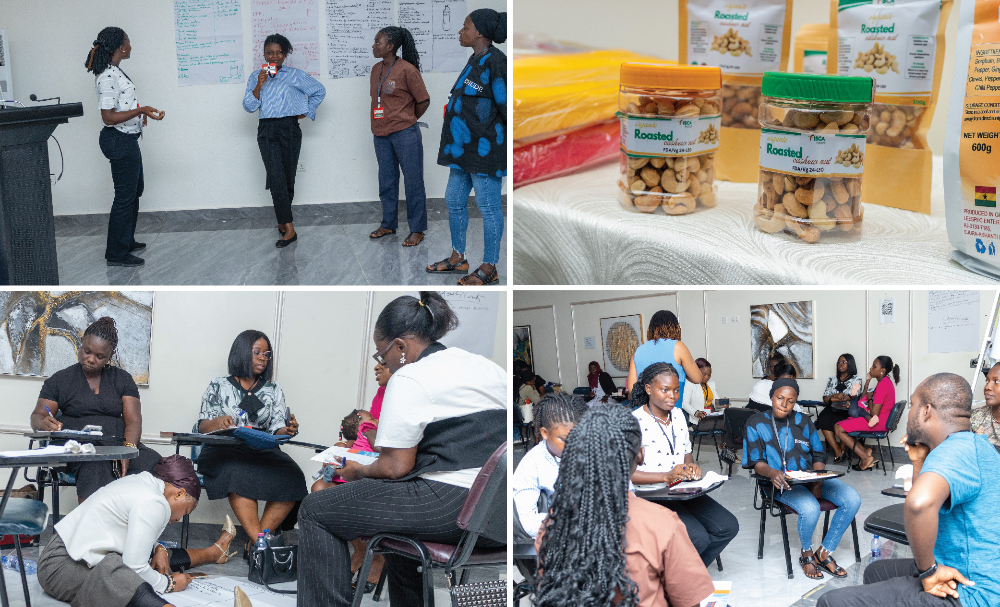
The KNUST Nutrition and Sustainable Agrifood Collaborative, in partnership with the Mastercard Foundation (Nkabom Collaborative) has commenced a five-day Business Development Training Programme aimed at strengthening the capacity of micro, small and medium enterprises (MSMEs) across Ghana.
The training programme, which brought together 25 participants from across the country, seeks to equip existing and aspiring entrepreneurs with practical skills in business planning and strategic management to enable them to build sustainable and scalable enterprises.
Participants are being introduced to the Nkabom Hybrid Business Model Canvas as a starting point for business planning. The model provides an overview of key business components, including value propositions, partnerships, customer segments, and differentiating factors.
Speaking at the training, the Entrepreneurship Pillar Lead of the Nkabom Collaborative, Prof. Wilberforce Owusu-Ansah, emphasised the critical role of business planning in entrepreneurial success. He noted that while many entrepreneurs start businesses without a clear plan, such an approach often leads to significant operational challenges.
“We recognise that many people start businesses without business plans, and inasmuch as this is common, it creates a lot of challenges in the long run,” he explained.
He added that the objective of the training is to build the capacity of SMEs and prospective start-ups by equipping them with the tools needed to develop strategic and workable business plans tailored to their enterprises.
“If businesses are guided with the right tools, they grow, recruit more people, and in that way, we help address the unemployment challenge,” he noted.
Facilitator Dr. Isaac Tweneboah-Koduah also highlighted the importance of combining technical agribusiness knowledge with strong business management skills to ensure the long-term sustainability of MSMEs.
He explained that the programme addresses critical areas such as brand positioning and marketing, noting that these components are essential for transforming MSME operations into profitable and competitive ventures.
“MSMEs may understand production or service delivery within the agrifood value chain, but turning that knowledge into a sustainable business requires a clear understanding of business models and financial management,” he said.
Another Facilitator, Gifty Afi Cudjoe underscored the significance of creativity tools within the programme, with particular emphasis on the SCAMPER guide, which was used to support participants during design thinking sessions. She explained that the tool encourages MSMEs to think beyond conventional ideas through structured prompts such as Substitute, Combine, Adapt, Modify, Put to another use, Eliminate and Reverse.
She noted that the guide played a crucial role in helping entrepreneurs refine their ideas and uncover fresh opportunities within their product offerings and business operations.
“The approach helps participants break mental barriers, challenge assumptions, and open new pathways for innovation,” she said.


